Sand-based greens
Low biological activity and limited nutrient holding capacity make leaching losses central. Rhizera builds activity where little exists and supports the root zone’s use of applied inputs.


What is in the jug
Live microbes are organisms. Applied to soil, they have to survive the tank, establish in the profile, compete with whatever is already living there, and multiply before they produce anything useful. That takes time, it depends heavily on conditions, and often it does not happen.
Metabolites are what those organisms produce while they work. Organic acids, enzymes, biosurfactants, growth-regulating compounds. These are the agents that act on the soil and the root zone. They are not alive, so they do not need to establish. They act on contact.
Most biological products ship only the organisms. Rhizera is fermented first, so the compounds are already formed and stable when the jug is opened. You get immediate activity from the metabolites and continuing activity from the microbes as they establish.
An inoculant is a promise. Metabolites are a delivery.
How much of either shows up on a given course depends on the profile you are starting with. This is a mechanism, not a guarantee.
Different profiles
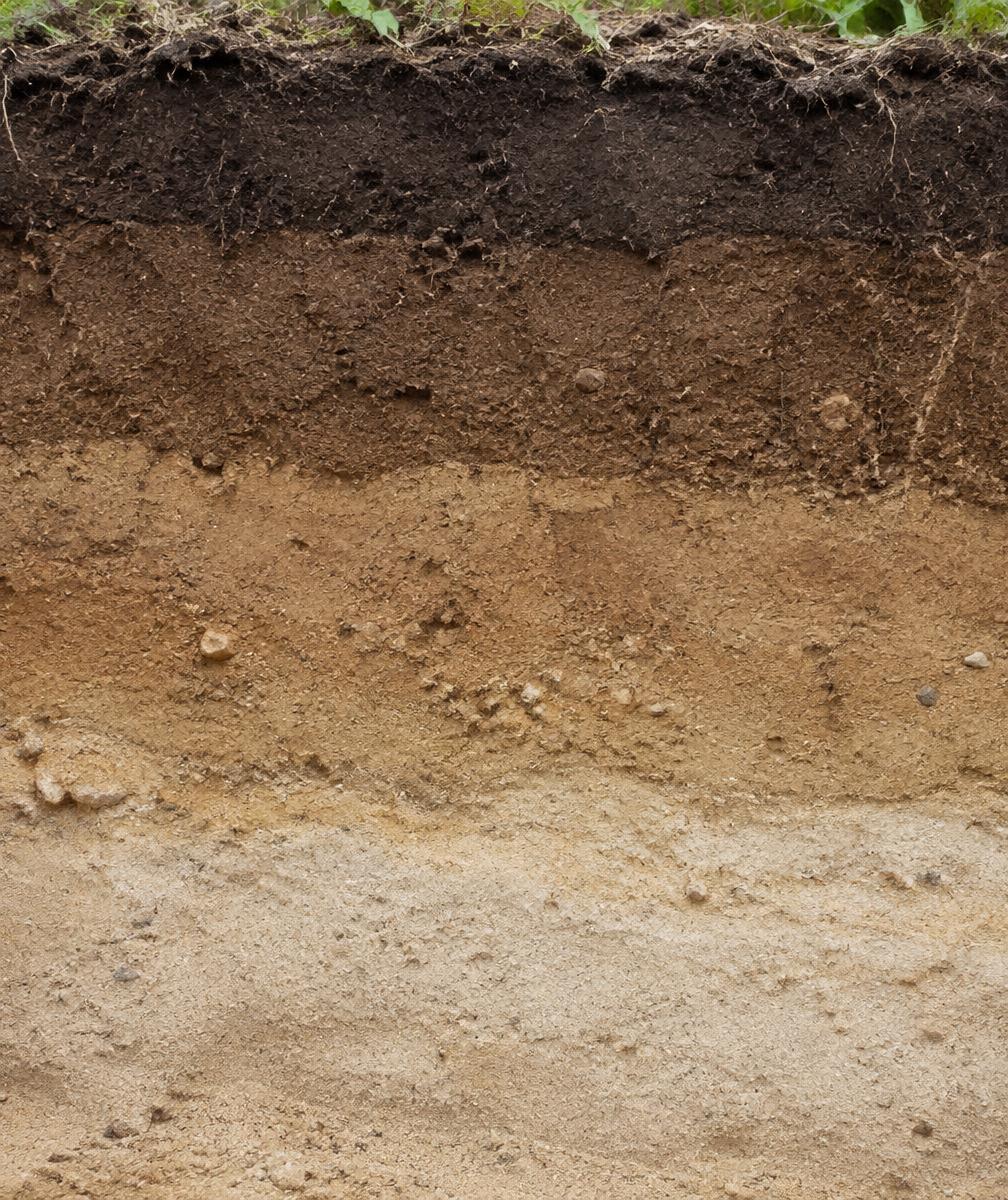
Low biological activity and limited nutrient holding capacity make leaching losses central. Rhizera builds activity where little exists and supports the root zone’s use of applied inputs.
On push-up greens, fairways, and tees, the work is aggregation, infiltration, compaction relief, thatch breakdown, and deeper rooting. Most of a course is native soil. That makes it the larger opportunity.
Mechanism
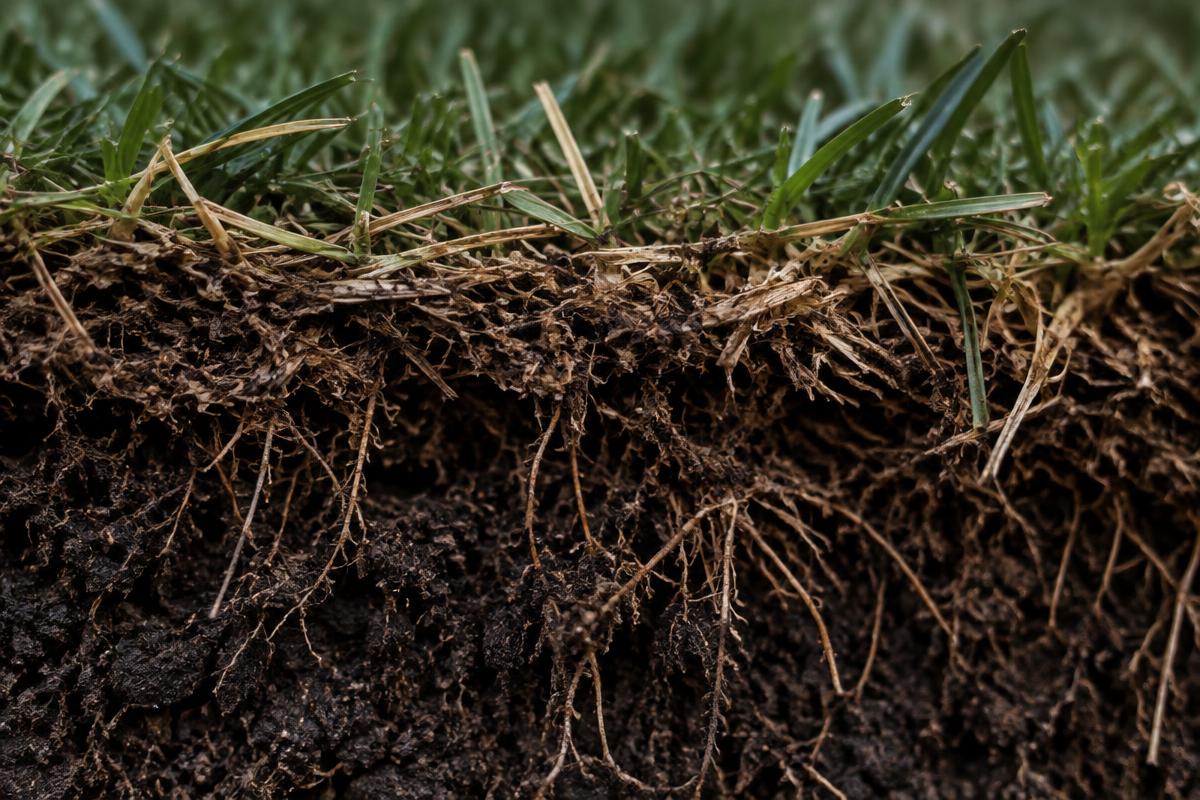
Biological activity supports the binding of soil particles into stable aggregates. The effect is most pronounced in clay-heavy and compacted profiles, which is where most fairway and push-up green soil sits.
Better aggregate structure opens pore space. Water moves down instead of sitting on the surface, and air reaches the root zone.
Accelerated breakdown of organic material increases the availability of nitrogen, phosphorus and micronutrients already present in the profile. This is availability, not addition.
Improved structure supports retention and reduces runoff, which matters most during heat and on slopes.
These are mechanisms, not guarantees. How much of each shows up on a given course depends on the profile you are starting with.
Plainly
Every biological product in this category has been oversold to you at least once. So here is the other side of it.
It is not a fertilizer. It will not replace your nitrogen.
It is not a wetting agent and will not substitute for one.
Results are clearest where the profile is under stress — compaction, poor infiltration, heavy thatch, heat. On a healthy, well-structured root zone the difference will be harder to see.
It will not fix a drainage problem, a shade problem, or a traffic problem. Those are construction and management issues and no biology will solve them.
It is not a one-time fix. A single application does not reset a root zone, and performance builds with consistent use across a season rather than arriving after the first pass.
Program fit
Application
Further reading
None of these are studies of Rhizera. They are the published work behind the approach, including one that complicates it. Linked research is independent and does not constitute an endorsement of this product.
Morcillo et al., Frontiers in Plant Science 13:1040515 (2022)
A review of why live inoculants are inconsistent in the field, and why the compounds microbes produce can be applied directly instead.
Horticulturae 11(12):1528 (2025)
A direct comparison of a live microbial product against its cell-free extract, in which the extract performed as well or better on several growth measures.
Mueller and Kussow, Crop Science (2005)
A field study on a USGA sand-based green in which commercial biostimulants improved putting green quality, but not through the microbial mechanism they claimed. Included because the category deserves the scrutiny.